
BAET is now Border Tuning – Different Name, Same Great Results
BAET is now Border Tuning –
Different Name, Same Great Results

100+ 5-Star Reviews
Turnaround
Warranty
Safe + Reliable Gains, 100% Dyno Proven
increases from
+
↑
PEAK POWER
increases from
+
↑
PEAK TORQUE
The Nissan D22 Navara fitted with the ZD30DI engine is a practical and capable platform, widely used for work, touring, and recreational four-wheel driving. The ZD30DI in the D22 is a first-generation direct injection diesel engine from the ZD30 family. Unlike the GU Patrol variant, the D22 version runs a wastegated turbocharger with mechanical boost control, rather than the electronically controlled VNT (Variable Nozzle Turbo) system used in the Patrol. The D22 also does not utilise a MAF sensor to guide fuelling strategies and does not incorporate an immobiliser system like the GU Patrol.
While the early ZD30 platform developed a mixed reputation in some applications, the D22 configuration is generally regarded as straightforward and robust when properly maintained. With correct calibration, these engines respond well to tuning — particularly in the low-to-mid RPM range where improved torque and drivability are most noticeable. When tuned within safe limits, the D22 ZD30DI benefits from stronger pulling power, improved throttle response, and more usable torque for towing or carrying loads.

Complete your online order with a list of your specifications and any modifications.

After you place your order, remove your ECU and send it in to our workshop without the brackets.
Once it arrives, we'll remap your ECU with a tune to suit and mail it back within 1-2 days of receiving.

Re-install your ECU, make any necessary adjustments and you're ready to go.
Complete your online order with a list of your specifications and any modifications.
Once we receive your order we'll begin remapping a second-hand ECU with a tune to suit.

Once your ECU is remapped we'll have it packaged and mailed directly to you.
Once it arrives, install the outright ECU, make any necessary adjustments and you're ready to go.
Complete your online order with a list of your specifications and any modifications.
We'll remap a second-hand ECU with a tune to suit and have it sent straight to you.
Once it arrives, install your ECU, make any adjustments and you're ready to go.

If everything is working as it should, package up your stock ECU with the prepaid satchel and mail it back.
Complete your online order with a list of your specifications and any modifications.

We'll send you a temporary loaner ECU to swap with, keeping you on the road while we have yours.
After you have the loaner ECU installed, mail in your own ECU with the prepaid satchel and we'll remap it.
Once your ECU is remapped, we'll mail it back. Re-install your ECU, make any necessary adjustments.
If everything is working as it should, package up our loaner ECU with the prepaid satchel and mail it back.
Service | Vehicle off the road? | ECU provided? | Keep stock ECU? | Immobiliser retained (if applicable) |
|---|---|---|---|---|
Send In | Yes | |||
Outright | No | |||
Exchange | No | |||
Loaner | No |
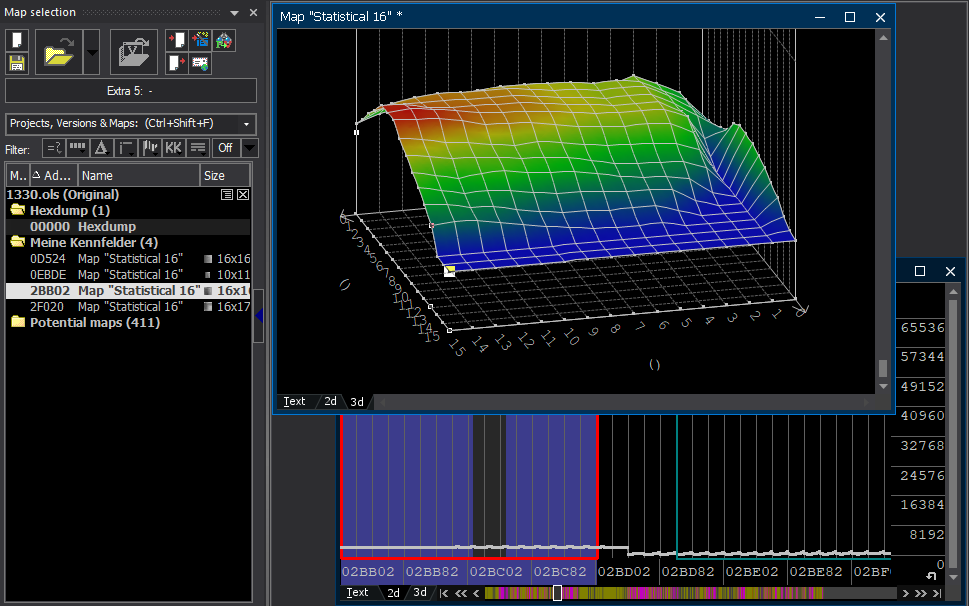
ECU remapping is a tuning method that involves modifying the tables and data stored within your vehicle’s factory Engine Control Unit (ECU or ECM), allowing us to alter how your engine runs - including fuel delivery, ignition timing, boost control, and more.
Because the changes are made within the ECU software itself, the ECU retains full control of engine operation. The engine runs in a closed-loop system, reacting properly to sensor data instead of being misled by altered signals like with alternative methods. All standard safety features and sensor feedback loops remain active as well.
This makes remapping one of the most comprehensive and integrated methods of tuning.
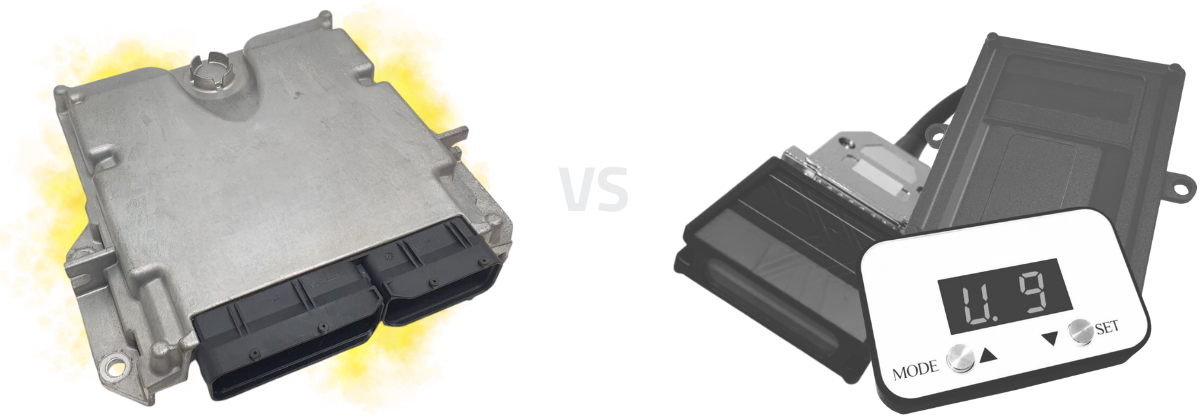
Performance chips, throttle controllers and other plug-in modules are 'piggyback' devices that connect to the vehicle wiring harness or sit just before the ECU to alter sensor signals. These devices can only do a small portion of what a remap can achieve, aren't as reliable and can be prone to fail.
Learn more about performance upgrades for your vehicle and what they can bring to your tune.
Got a question that’s not answered here? Check out our knowledge base articles.
Absolutely – we aim to stay on the more conservative side of things especially when it comes to mail order tunes. Each car is slightly different and staying on the conservative side allows us to keep each car reliable without needing to put each and every car on a dyno.
Fuel economy can be a difficult thing to quantify especially when you’ve just installed a remapped ECU and are keen to use the extra power and torque available to you.
If your driving style hasn’t changed from when you fitted the remapped ECU increases in fuel economy typically up to 10% can be achieved but is dependant on the car and driving style.
Generally speaking fuel economy won’t be that much better in the first couple of weeks, let’s call it the ‘honeymoon period’ when people like to drive harder than they normally would because of the extra power. After this period when driving styles relax and go back to how they were pre-tune fuel economy will usually appear better.
With forced induction diesel vehicles we can often achieve great gains in power and torque with no/minimal supporting modifications.
Some vehicles/engines will respond better to a tune with certain supporting modifications. Typically the more support modifications on the vehicle the higher the gains in power and torque. If you’re unsure, we are able to make recommendations on suitable supporting modifications to get the best value for your money.
If purchasing our send in option you will need to remove the ECU from your vehicle and send it in to us. We do our best to turn them around ASAP as we understand it can be difficult to have daily driven cars off the road.
If you’re unable to have your vehicle off the road look into our exchange, loaner or outright options (if available) or contact us to see what solutions we may have for you.

The data depicted on the graphs is real world data from vehicles tested and verified on our dyno.
Each vehicle can respond differently depending on mods and age. Values from other dynos will differ and will change upon factors such as dyno brand, strapping methods, tyre size, environmental conditions etc.
Custom Tuning Service
Using a dyno or dynamometer, we can measure the produced power, torque, boost, air fuel ratio (AFR) and more of your engine. With all this data in hand, our expert tuners can determine how your engine is performing and design a tune that’s suitable for your vehicle.

Welcome to the Workshop
Check what you’ll need before and after your ECU remap. Please read carefully as some will affect the outcome of your tune.
Injector Upgrade Guide
Fuel injectors play a critical role in how much power the ZD30DI can safely produce.
While the factory injectors are suitable for stock and mild tuning applications, they become a limiting factor once airflow and boost levels are increased beyond basic “Stage 1” levels.
Regardless of performance upgrades, it is generally recommended to:
As injectors age, spray patterns can degrade and flow consistency can change. This affects performance, efficiency, and reliability — even on stock vehicles.
The factory ZD30DI injectors are fairly limited in flow capacity.
For mild tuning on a stock turbo setup, they are typically adequate. However, once moving beyond a basic “Stage 2” tune (refer to dyno graphs on the vehicle page), high-flow injectors are required to achieve further gains safely and effectively.
Without increased injector capacity, additional airflow from turbo upgrades cannot be fully utilised.
There are now many suppliers offering high-flow injectors for the ZD30DI platform.
We primarily tune with Diesel Central high-flow injectors, as they have proven over time to be reliable and consistent in both flow and build quality.
High-flow injectors are typically available in approximate sizing increments of:
These percentages refer to increased fuel flow capacity compared to factory injectors.
It is important to select an injector size that aligns with your power and torque goals.
We generally recommend:
We can tune any injector size combination and, if required, even calibrate larger injectors back down to stock-like power levels. However, correct sizing simplifies the setup and improves overall drivability.
High-flow injectors must be tuned for immediately after installation.
Installing larger injectors without recalibrating the ECU will result in:
The ECU must be properly calibrated to match the new injector flow characteristics.
High-flow injectors do not automatically increase fuel consumption.
Injectors only supply more fuel when commanded to do so by the ECU. When tuned correctly:
Injector size simply increases the engine’s potential fuel delivery — it does not force the engine to use more fuel at all times.
Injectors are one of the key supporting upgrades when moving beyond mild tuning. Selecting the correct size and pairing them with appropriate turbo and intercooler upgrades ensures a balanced, reliable setup.
Turbo Upgrade Guide
The D22 Navara ZD30DI comes factory-equipped with a wastegated turbocharger. While simple and reliable, it offers a narrower usable power band compared to a VNT (Variable Nozzle Turbo) setup.
Upgrading the turbo is one of the most effective ways to improve both power and drivability on this platform.
There are several basic high-flow turbo options available that are direct bolt-on replacements for the factory unit.
These typically offer:
For moderate builds, a high-flow wastegated turbo can provide worthwhile gains without significant changes to supporting components.
However, while these improve peak flow, they do not dramatically change the shape of the torque curve.
A more substantial upgrade is converting the D22 to run a Patrol ZD30DI VNT turbo.
The VNT system offers:
This conversion significantly broadens the power delivery compared to the factory wastegated setup.
To perform the VNT conversion, you typically need:
In many cases, the Patrol turbo’s hotside is used to suit the Navara configuration.
Once converted to VNT, the platform opens up access to many of the same higher-end turbo upgrade options available to the Patrol market.
After converting to a VNT-based setup, the same manufacturers discussed in the Patrol ZD30DI turbo article become relevant, including:
These offer upgraded and performance VNT options suited to larger injector and intercooler setups.
As with the Patrol platform:
The factory turbo on the Navara is generally efficient up to typical factory boost levels (~15–16 PSI). Once moving beyond this range, proper calibration becomes critical.
The factory wastegated turbo:
A VNT turbo:
For those wanting improved drivability and a broader power band, the VNT conversion is typically the better long-term upgrade path.
The best turbo choice depends on your goals — whether that’s a modest power increase or a full performance build. Planning the turbo upgrade alongside injector and intercooler upgrades results in a far more balanced setup.
Exhaust Upgrade Guide
Upgrading the exhaust system is one of the most common modifications performed on the ZD30DI D22 Navara.
For most builds, the typical upgrade is a 3-inch turbo-back exhaust system, replacing the factory dump pipe, catalytic converter, and rear exhaust sections.
On a turbocharged engine, the goal of the exhaust system is to allow spent gases to exit the turbine as efficiently as possible.
There is effectively no such thing as “too large” of an exhaust on a turbocharged engine within practical packaging limits. The turbocharger itself provides all the back pressure the engine will ever require. Reducing post-turbine restriction:
For tuned vehicles, a freer-flowing exhaust supports safer and more consistent performance.
For a completely stock vehicle with a very basic tune, the factory exhaust is generally adequate.
However, once you move beyond mild tuning — especially with:
a 3-inch turbo-back system is strongly recommended.
For most applications, we recommend:
This setup:
It strikes a good balance between performance, comfort, and compliance.
There are many brands available on the market, ranging widely in price and quality.
Lower-cost systems can sometimes suffer from:
A poorly fitting exhaust can cause stress on mounts and lead to long-term durability issues. Choosing a reputable brand with good fitment history is important.
When purchasing an exhaust system, it is highly recommended to choose one with a pre-installed EGT (Exhaust Gas Temperature) probe bung.
Even if you don’t plan on installing a gauge immediately:
Planning ahead makes future upgrades much easier.
The factory exhaust is acceptable for mild tuning, but upgrades are recommended for higher performance builds
An exhaust upgrade is one of the foundational supporting modifications for a tuned ZD30DI D22 Navara — particularly when reliability under load is a priority.
Intercooler Upgrade Guide
One of the biggest differences between the D22 Navara ZD30DI and the GU Patrol ZD30DI is that the Navara is not intercooled from factory.
Because of this, intake air temperatures (IATs) can become quite high — particularly when towing, climbing long hills, or driving in hot conditions.
Installing an intercooler is one of the most noticeable and worthwhile upgrades on the D22 platform.
Without an intercooler, compressed air from the turbo goes straight into the engine. As air is compressed, it heats up. Hot air is less dense, which reduces oxygen content and therefore limits power.
High intake air temperatures can result in:
Even on a stock turbo and stock tune, fitting a basic intercooler will typically result in:
You may not notice a huge peak power increase, but you will notice improved consistency under load.
A common upgrade path is fitting a GU Patrol ZD30DI top-mount intercooler to the D22.
To do this, typically required:
A body lift can make the installation process easier by providing additional clearance.
While this is a proven solution, it does require fabrication and supporting modifications.
Front-mount intercoolers (FMIC) are generally the preferred option for the D22.
Advantages include:
There are several pre-fabricated front-mount kits available on the market.
HPD offers a well-known and proven front-mount kit for the D22 platform.
Front-mount systems typically offer the best overall thermal performance, especially for vehicles used for towing or sustained heavy load.
There are also custom intercooler options available, including:
These require careful planning to ensure:
As with any intercooler setup, core quality and internal fin design are important — not just physical size.
For the D22 Navara, adding an intercooler is one of the most beneficial performance and reliability upgrades — particularly for towing and long-distance driving.
Airbox Upgrade Guide
Airbox upgrades on the D22 Navara ZD30DI follow similar principles to the GU Patrol ZD30DI — reduce intake restriction, improve sealing, and support increased airflow where required.
However, on the D22 specifically, the factory airbox has a few more limitations.
The factory D22 airbox is:
For a completely stock vehicle, it functions adequately. However, once tuning is introduced — even at a basic level — the factory airbox can become a noticeable restriction.
Unlike some vehicles where airbox upgrades provide minimal gains, the D22 Navara often responds noticeably to intake improvements.
Even with a basic tune, upgrading the airbox can result in:
While peak power gains may not be dramatic on a stock turbo setup, drivability improvements are often felt immediately.
One important consideration is snorkel integration.
Because the factory airbox does not seal particularly well, fitting a snorkel to a stock airbox does not always guarantee proper water or dust sealing.
An upgraded airbox:
For vehicles used off-road, touring, or in dusty conditions, this is a significant benefit.
An older and once-popular upgrade was fitting an 80 Series LandCruiser airbox, which offered better sealing and airflow than the factory Navara unit.
Today, there are many purpose-built aftermarket options available that:
As with any intake system, build quality and proven sealing performance are important — especially for vehicles regularly exposed to dust or water crossings.
On the D22 ZD30DI, upgrading the airbox is both a performance and reliability improvement — especially for off-road and touring applications.
Tuning Services
Send In
Remove the ECU from your vehicle and mail it in to our workshop to be remapped. We will always prioritise these orders within a day of receiving to get you back on the road.
Outright
We provide a fully remapped second-hand ECU from a trusted spare parts supplier. This gives you the option to keep your stock ECU as well as having a tuned one.
Exchange
We send you a fully remapped second-hand ECU from a trusted spare parts supplier. Once it arrives, you return your stock ECU to us with a prepaid satchel.
Loaner
We send you a temporary stock ECU to keep you on the road before you mail in yours to be remapped.